
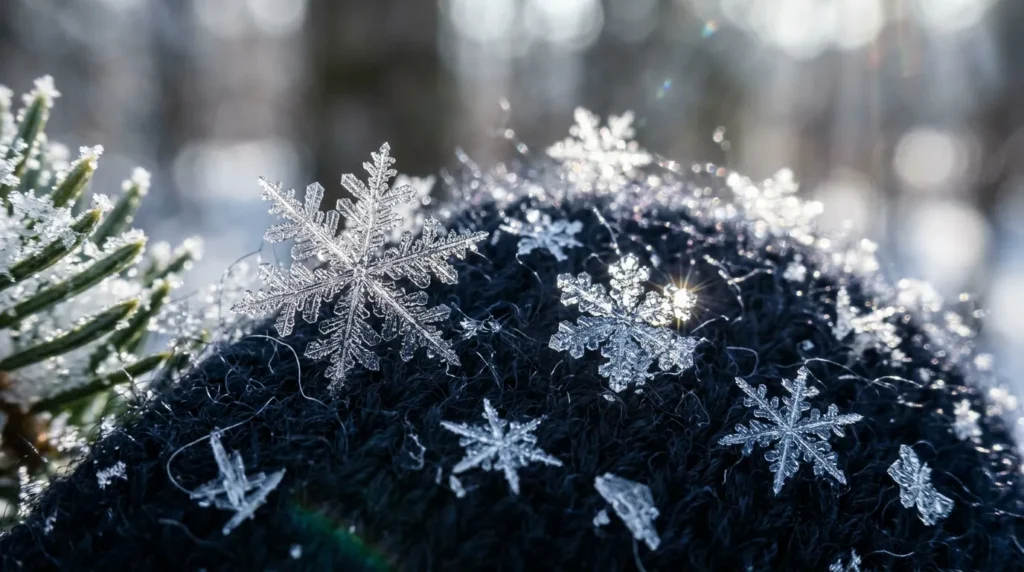
What Is a Simile for Snowflakes?
A simile for snowflakes is a figure of speech that compares snowflakes to something else using the words like or as. It highlights a shared quality, such as appearance, movement, size, or delicacy.
For example, “The snowflakes floated like feathers in the wind.” This comparison emphasizes how gently and lightly snowflakes move through the air.
Writers use snowflake similes to create vivid mental pictures, establish a peaceful winter mood, and make descriptions more memorable.
35 Similes for Snowflakes With Meanings and Examples
1. Snowflakes Like Feathers
Meaning: This simile describes snowflakes drifting gently through the air, just as soft feathers float on a breeze.
Quote: “Snowflakes drifted like feathers from the quiet winter sky.”
Examples:
The snowflakes floated like feathers past my bedroom window.
White flakes fell like feathers onto the sleeping garden.
Outside, the snow drifted like feathers across the empty road.
2. Snowflakes Like Tiny Stars
Meaning: This comparison highlights the sparkling appearance of snowflakes when sunlight or moonlight reflects off their icy surfaces.
Quote: “Tiny snowflakes glittered like stars scattered across the morning sky.”
Examples:
The snowflakes shone like tiny stars beneath the streetlights.
Each crystal sparkled like a star on my winter coat.
Under the moon, the snow glittered like stars scattered across the ground.

3. Snowflakes Like Diamonds
Meaning: Snowflakes resemble diamonds when their icy surfaces catch and reflect bright light.
Quote: “The fresh snow sparkled like diamonds in the afternoon sunshine.”
Examples:
Snowflakes glistened like diamonds on the pine branches.
The frozen field glittered like diamonds after sunrise.
Each tiny crystal shone like a diamond against my dark glove.
4. Snowflakes Like White Butterflies
Meaning: This simile emphasizes the graceful, fluttering movement of snowflakes as they twist and turn through the air.
Quote: “White snowflakes danced like butterflies above the garden fence.”
Examples:
Snowflakes fluttered like white butterflies outside the classroom.
The flakes swirled like butterflies around the bare trees.
A few snowflakes floated like butterflies past the porch.
5. Snowflakes Like Cotton Balls
Meaning: This comparison describes snowflakes as soft-looking, fluffy, and white.
Quote: “The snow fell like cotton balls from a pale winter sky.”
Examples:
Large flakes tumbled like cotton balls onto the lawn.
Snowflakes looked like tiny cotton balls against the dark window.
The children watched fluffy snow fall like cotton balls over the playground.
6. Snowflakes Like Confetti
Meaning: Snowflakes resemble confetti when they swirl through the air in a lively, scattered pattern.
Quote: “The sky tossed snowflakes like confetti over the celebrating town.”
Examples:
Snowflakes swirled like confetti during the winter festival.
The wind scattered flakes like confetti across the street.
White snow floated like confetti above the cheering children.
7. Snowflakes Like Tiny Flowers
Meaning: This simile draws attention to the delicate, symmetrical patterns found in many snow crystals.
Quote: “Each snowflake opened like a tiny flower against my mitten.”
Examples:
The crystal rested like a tiny flower on the dark fabric.
Snowflakes formed delicate patterns like little flowers on the glass.
Under the magnifying glass, each flake looked like a frozen flower.
8. Snowflakes Like Dancing Fairies
Meaning: This imaginative comparison gives falling snow a magical, playful quality.
Quote: “Snowflakes danced like fairies through the enchanted winter forest.”
Examples:
The children imagined snowflakes dancing like fairies around the trees.
In the moonlight, flakes twirled like tiny fairies.
Snowflakes floated like fairies above the frozen pond.
9. Snowflakes Like White Lace
Meaning: This simile describes the intricate, delicate patterns snowflakes can create on windows and branches.
Quote: “Frost and snow decorated the window like delicate white lace.”
Examples:
Snowflakes settled like white lace along the evergreen branches.
The icy patterns spread like lace across the glass.
Fine snow covered the fence like a layer of lace.
10. Snowflakes Like Tiny Pieces of Glass
Meaning: This comparison emphasizes the crystalline appearance of snowflakes, especially when they sparkle in bright light.
Quote: “The snowflakes gleamed like tiny pieces of glass in the sunlight.”
Examples:
The icy crystals shone like tiny pieces of glass on the railing.
Snow glittered like broken glass scattered across the frozen path.
Each crystal flashed like a tiny piece of glass before melting.
11. Snowflakes Like Whispering Secrets
Meaning: This poetic simile suggests that snowflakes fall so quietly they seem to carry secret messages from the sky.
Quote: “Snowflakes descended like whispers from a silent winter cloud.”
Examples:
The flakes fell like whispered secrets into the silent forest.
Snow drifted like a quiet message from the clouds.
Each snowflake landed like a whisper on the windowsill.
12. Snowflakes Like Floating Feathers on a Breeze
Meaning: This comparison emphasizes the lightness and unpredictable movement of snowflakes carried by the wind.
Quote: “The snowflakes floated like feathers on a gentle winter breeze.”
Examples:
Small flakes drifted like feathers above the frozen lake.
The wind carried snowflakes like loose feathers across the field.
Snow floated like feathers through the open barn door.
13. Snowflakes Like Silver Dust
Meaning: This simile describes the fine, shimmering appearance of snowflakes in moonlight or bright sunlight.
Quote: “Silver snowflakes shimmered like dust in the moonlight.”
Examples:
The falling flakes glittered like silver dust beneath the lamps.
A thin snowfall sparkled like silver dust on the rooftops.
The night sky released snowflakes like shimmering silver dust.
14. Snowflakes Like Tiny Paper Boats
Meaning: This imaginative comparison describes flakes that drift and tilt as if they were small boats sailing through the air.
Quote: “Snowflakes sailed like tiny paper boats through the chilly breeze.”
Examples:
The flakes bobbed like paper boats on an invisible current.
Snowflakes drifted like tiny boats above the garden.
A gust carried the flakes like paper boats across the street.
15. Snowflakes Like White Petals
Meaning: This simile emphasizes the delicate, graceful appearance of snowflakes as they fall.
Quote: “White snowflakes fluttered like petals from a winter blossom.”
Examples:
The flakes fell like white petals around the mailbox.
Snow drifted like flower petals across the quiet park.
Each snowflake landed like a petal on the frozen pond.
16. Snowflakes Like Tiny Crystals
Meaning: This comparison highlights the geometric shapes and icy sparkle of individual snowflakes.
Quote: “The snowflakes glittered like tiny crystals in the morning light.”
Examples:
Each flake looked like a tiny crystal on the black mitten.
The snow sparkled like crystals across the hillside.
Bright crystals of snow shone like tiny jewels on the branches.
17. Snowflakes Like a Gentle Curtain
Meaning: This simile describes heavy or steady snowfall that partially hides the landscape behind a moving veil of white.
Quote: “Snow fell like a gentle curtain across the distant mountains.”
Examples:
A curtain of snow drifted like a veil between us and the hills.
The flakes descended like a white curtain over the village.
From the window, I watched snow fall like a curtain across the road.
18. Snowflakes Like White Dancers
Meaning: This comparison portrays snowflakes as graceful performers moving in different directions.
Quote: “Snowflakes spun like white dancers beneath the winter clouds.”
Examples:
The flakes twirled like dancers above the schoolyard.
Snowflakes moved like graceful dancers in the wind.
The storm sent white dancers swirling around the streetlights.
19. Snowflakes Like Tiny Feathers of Ice
Meaning: This simile combines the softness associated with feathers and the frozen nature of snowflakes.
Quote: “Tiny feathers of ice drifted gently onto the frozen lake.”
Examples:
Snowflakes floated like icy feathers around the pine trees.
Each flake landed like a feather made of ice.
The wind carried tiny icy feathers across the field.
20. Snowflakes Like Sprinkles on a Cake
Meaning: This comparison describes snowflakes scattered over a surface in a decorative, playful way.
Quote: “Fresh snow dusted the garden like sprinkles on a winter cake.”
Examples:
Snowflakes dotted the dark roof like white cake sprinkles.
The first snowfall scattered across the lawn like sugar sprinkles.
Tiny flakes decorated the bushes like sprinkles on frosting.
21. Snowflakes Like White Moths
Meaning: This simile emphasizes the fluttering motion of snowflakes, especially when they move around lights at night.
Quote: “Snowflakes fluttered like white moths around the glowing lantern.”
Examples:
The flakes swirled like moths beneath the porch light.
Snowflakes danced like white moths around the streetlamp.
Against the dark sky, each flake looked like a little moth.
22. Snowflakes Like Tiny Mirrors
Meaning: This comparison highlights how snow crystals can reflect light and sparkle from different angles.
Quote: “The snowflakes flashed like tiny mirrors in the winter sun.”
Examples:
The crystals reflected sunlight like tiny mirrors on the windowsill.
Snow glittered like a thousand little mirrors across the field.
Each flake caught the light like a miniature mirror.
23. Snowflakes Like Whispering Birds
Meaning: This poetic simile gives snowflakes a sense of quiet movement, as if they were small birds gliding silently through the air.
Quote: “Snowflakes glided like silent birds above the sleeping village.”
Examples:
The flakes drifted like quiet birds over the rooftops.
Snowflakes glided like white birds across the gray sky.
The gentle snowfall moved like a flock of silent birds.
24. Snowflakes Like White Buttercream
Meaning: This comparison describes the soft, creamy-white appearance of snow resting on branches, rooftops, and other surfaces.
Quote: “The fresh snow covered the garden like smooth white buttercream.”
Examples:
Snow coated the roof like a layer of buttercream.
The branches looked frosted like a winter cake.
White snow spread like icing across the garden wall.
25. Snowflakes Like Tiny Lanterns
Meaning: This imaginative simile describes flakes that catch the light and seem to glow against a dark background.
Quote: “Snowflakes glowed like tiny lanterns beneath the streetlights.”
Examples:
The falling flakes shone like little lanterns in the evening.
Snowflakes glimmered like lanterns against the dark trees.
Each crystal seemed to glow like a tiny light in the night.
26. Snowflakes Like a Thousand Little Wishes
Meaning: This poetic comparison gives snowfall a hopeful, dreamy feeling, as if every flake carries a wish.
Quote: “Snowflakes drifted like a thousand little wishes into the quiet town.”
Examples:
The children watched their wishes fall like snowflakes from the sky.
Each flake floated like a tiny wish waiting to come true.
Snow filled the evening air like a thousand whispered hopes.
27. Snowflakes Like White Sparks
Meaning: This simile describes the bright flashes of snowflakes as they catch light against a dark sky.
Quote: “Snowflakes flashed like white sparks in the freezing night.”
Examples:
The flakes glittered like sparks beneath the streetlamp.
White snowflakes flickered like tiny sparks in the headlights.
The wind tossed bright flakes like sparks across the road.
28. Snowflakes Like Tiny Pinwheels
Meaning: This comparison describes snowflakes spinning and changing direction as gusts of wind carry them.
Quote: “The snowflakes spun like tiny pinwheels in the playful breeze.”
Examples:
The flakes whirled like pinwheels above the playground.
Snowflakes twisted like little pinwheels near the fence.
A sudden gust sent the flakes spinning like miniature pinwheels.
29. Snowflakes Like White Silk
Meaning: This simile emphasizes the smooth, delicate, and flowing appearance of snowfall when it drifts across a landscape.
Quote: “Snow spread like white silk over the sleeping fields.”
Examples:
A fine layer of snow covered the garden like silk.
Snowflakes drifted like silk threads through the air.
The white landscape shimmered like silk beneath the moon.
30. Snowflakes Like Tiny Ice Sculptures
Meaning: This comparison highlights the intricate shapes and unique patterns of snow crystals.
Quote: “Each snowflake rested like a tiny ice sculpture on my sleeve.”
Examples:
The crystal looked like a miniature sculpture on the mitten.
Snowflakes formed intricate patterns like tiny frozen sculptures.
Under a magnifying glass, each flake resembled a delicate ice sculpture.
31. Snowflakes Like White Doves
Meaning: This simile suggests a peaceful, graceful snowfall, using doves as symbols of calmness and gentleness.
Quote: “Snowflakes descended like white doves into the silent valley.”
Examples:
The flakes floated like white doves above the frozen river.
Snow drifted like a flock of doves across the garden.
The gentle snowfall moved like doves gliding through the air.
32. Snowflakes Like Tiny Stars Falling to Earth
Meaning: This poetic comparison makes snowflakes seem magical, as though the night sky were sending stars down to the ground.
Quote: “Snowflakes fell like tiny stars landing softly on the earth.”
Examples:
The children watched flakes fall like stars from the winter sky.
Under the moon, the snowfall looked like stars descending to earth.
Each crystal glittered like a fallen star on the dark pavement.
33. Snowflakes Like White Beads
Meaning: This simile describes small, distinct flakes that dot clothing, branches, or the ground.
Quote: “Snowflakes gathered like tiny white beads along the edge of my scarf.”
Examples:
The flakes rested like beads on the evergreen needles.
Small snow crystals dotted the railing like white beads.
Snowflakes clung to my hat like tiny pearls.
34. Snowflakes Like a Painter’s Brushstrokes
Meaning: This comparison presents snowfall as if an artist were gently adding white details to a landscape.
Quote: “Snowflakes swept across the hillside like brushstrokes on a winter canvas.”
Examples:
The falling snow painted the branches like delicate brushstrokes.
White flakes spread across the field like strokes of a paintbrush.
The storm transformed the village like an artist painting a fresh scene.
35. Snowflakes Like Dreams Drifting Down
Meaning: This imaginative simile gives snowfall a peaceful, magical quality, making each flake seem delicate and unreal.
Quote: “Snowflakes drifted like dreams through the still winter air.”
Examples:
The flakes floated like dreams beyond the bedroom window.
Snow descended like a dream over the sleeping town.
Each snowflake seemed like a little dream landing on the earth.
Short Similes for Snowflakes
Sometimes, a short comparison is all you need for a caption, poem, classroom activity, or creative-writing exercise. These quick snowflake similes are easy to remember and use.
Like feathers: Snowflakes floated like feathers.
Like stars: The snow sparkled like stars.
Like diamonds: The flakes shone like diamonds.
Like petals: Snowflakes fell like petals.
Like lace: Snow covered the branches like lace.
Like confetti: Snow swirled like confetti.
Like cotton: The flakes looked like cotton.
Like butterflies: Snowflakes fluttered like butterflies.
Like silver dust: The snow shimmered like silver dust.
Like tiny jewels: Each flake glittered like a tiny jewel.
Like white dancers: Snowflakes spun like white dancers.
Like whispers: Snow fell like whispers from the sky.
Similes for Snowflakes in Poems
Snowflake similes can make winter poetry more vivid by adding movement, emotion, sound, and imagery. The best comparison depends on the mood you want to create.
For a peaceful winter poem
Snowflakes drifted like feathers through the sleeping trees.
The snow fell like whispers across the silent meadow.
White flakes floated like doves beneath the pale moon.
For a magical winter poem
Snowflakes glittered like stars released from the sky.
Each crystal descended like a tiny frozen wish.
The snow danced like fairies beneath the silver clouds.
For a cheerful winter poem
Snowflakes swirled like confetti above the playground.
White flakes fluttered like butterflies around the children.
The snow sparkled like diamonds on a sunny morning.
For a sad or lonely winter poem
Snowflakes drifted like forgotten letters through the empty street.
The flakes fell like quiet tears from a gray sky.
Snow settled like a pale veil over the abandoned house.
These examples can help you establish a mood before developing a complete poem. For more ideas, explore related topics such as similes for nature, similes for winter, and similes for creative writing.
Similes for Snowflakes for Kids
Children often understand similes more easily when the comparisons involve familiar objects and simple images. These examples are suitable for elementary school assignments, worksheets, and classroom discussions.
Snowflakes are like feathers floating in the air.
Snowflakes sparkle like tiny stars.
Snow falls like sprinkles on a cake.
Snowflakes dance like butterflies.
Snowflakes look like little flowers.
Snow covers the ground like a white blanket.
Snowflakes shine like diamonds.
Snowflakes fall like white petals.
Snowflakes swirl like confetti.
Snowflakes float like tiny clouds.
Classroom activity: Ask students to choose one simile and draw a picture that represents it. Then have them write their own sentence using like or as to compare a snowflake with something familiar.
For example: “The snowflake landed on my hand like a tiny flower.”
How to Write Your Own Similes for Snowflakes
You don’t need to be a professional poet to create an original snowflake simile. Start by observing what snowflakes look like and how they behave.
1. Notice their appearance. Snowflakes can look delicate, bright, white, crystalline, or star-shaped. Think of objects with similar features, such as lace, diamonds, or flowers.
2. Think about their movement. Falling snow may drift, flutter, swirl, or spin. Compare that movement with feathers, butterflies, dancers, or leaves.
3. Choose the mood. A comparison involving stars may feel magical, while one involving whispers can suggest peace or loneliness.
4. Use like or as. These words help establish a clear comparison. For example, “The snowflakes were as delicate as flower petals.”
5. Read the sentence aloud. Make sure the simile sounds natural and communicates the image you want the reader to imagine.
The most effective similes are not necessarily the most complicated. A simple, accurate comparison can be more memorable than an elaborate one.
Simile vs. Metaphor: What’s the Difference?
Similes and metaphors both help readers understand an idea through comparison, but they express that comparison differently.
Simile: Uses like or as to compare two things. Example: “The snowflakes sparkled like diamonds.”
Metaphor: Describes one thing as another without using like or as. Example: “The snowflakes were diamonds scattered across the lawn.”
Both techniques can make descriptions of snow more vivid. A simile makes the comparison explicit, while a metaphor presents the image more directly.
For additional examples, explore our related topics on simile and metaphor examples and similes for kids.