
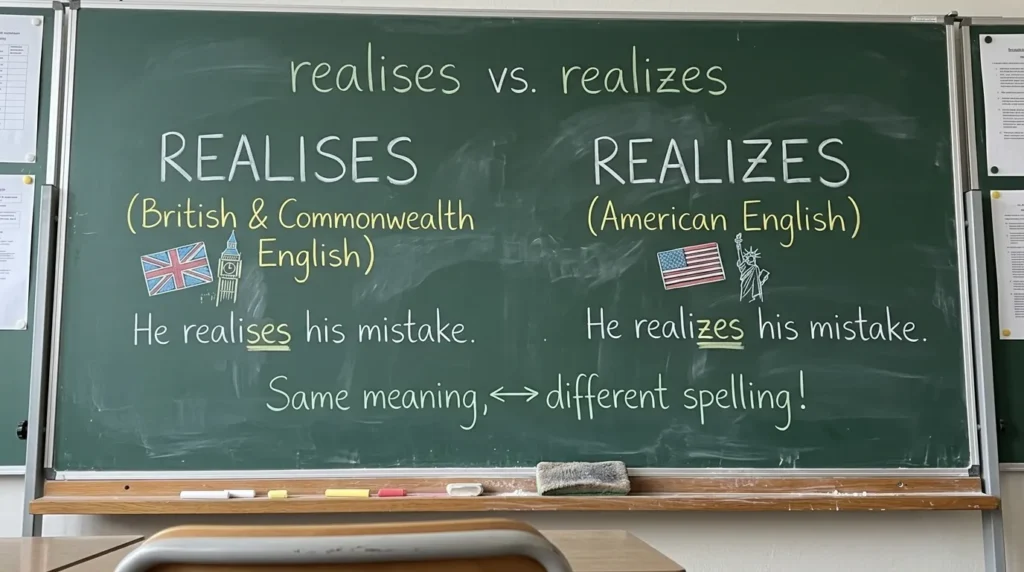
Realises vs Realizes: Quick Difference
| Word | Correct Usage | Example |
|---|---|---|
| Realises | British English | She realises her mistake. |
| Realizes | American English | She realizes her mistake. |
Both words are present-tense forms of the verb realise or realize. They are used with singular third-person subjects, such as he, she, and it.
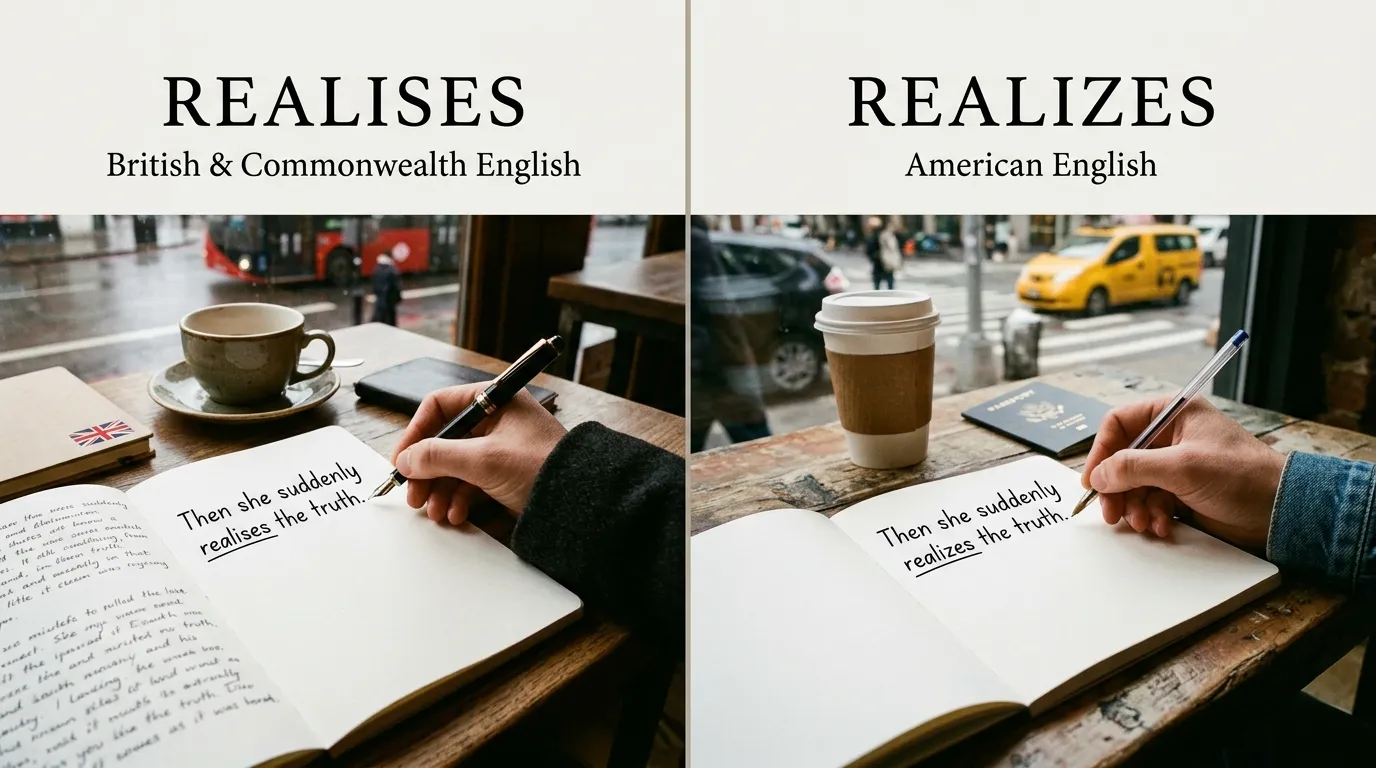
What Does Realises Mean?
Realises is the British English spelling of the verb meaning to become aware of something, understand a situation, or recognize a fact.
It is commonly used in the United Kingdom and in other varieties of English that follow British spelling conventions.
Examples of Realises in a Sentence
She realises that she left her phone at home.
He realises how important his education is.
The teacher realises that the student needs extra help.
When Mia reads the message, she realises the truth.
Daniel realises he has made a serious mistake.
In each sentence, realises describes someone becoming aware of something or understanding a situation.
What Does Realizes Mean?
Realizes is the American English spelling of the same verb. It has the same meaning as realises and is used when someone becomes aware of something, understands a fact, or recognizes a situation.
This spelling is standard in the United States and is widely used in American books, newspapers, websites, and academic writing.
Examples of Realizes in a Sentence
She realizes that she forgot her keys.
He realizes the importance of hard work.
The manager realizes that the plan needs improvement.
Emma realizes she has misunderstood the question.
Jack realizes that his friends were right.
These examples show that realizes has exactly the same meaning as realises. Only the spelling changes.
Why Do Realises and Realizes Have Different Spellings?
The difference comes from regional spelling conventions.
British English often uses -ise, as in realise, organise, and recognise. American English commonly uses -ize, as in realize, organize, and recognize.
However, the spelling rules are not completely uniform across all English-speaking countries. Some British dictionaries and style guides also accept or prefer -ize spellings. Therefore, realizes is not exclusively American, even though it is the usual American spelling.
The most important rule is to follow one spelling style consistently throughout your writing.
Realises vs Realizes: Examples in Different Contexts
Here are some examples showing how both spellings work in everyday writing.
1. Everyday Conversation
British English: She realises she is running late.
American English: She realizes she is running late.
2. School and Education
British English: The student realises why the answer is incorrect.
American English: The student realizes why the answer is incorrect.
3. Work and Business
British English: The company realises the value of customer feedback.
American English: The company realizes the value of customer feedback.
4. Personal Growth
British English: He realises that patience is important.
American English: He realizes that patience is important.
Each pair communicates the same idea. Choose the spelling that matches your intended English style.
How to Remember the Difference
A simple way to remember the difference is to focus on your audience.
Realises: Usually choose this spelling when following British English conventions.
Realizes: Choose this spelling when following American English conventions.
If you are writing for a US-based audience, use realizes. If your writing follows British English, use realises, unless your chosen style guide specifies otherwise.
For a website, consistency is especially important. Avoid switching between forms such as realises and organizes without a reason.
Common Mistakes to Avoid
One common mistake is assuming that one spelling is correct and the other is wrong. In fact, both are accepted spellings, but they belong to different spelling conventions.
Another mistake is using both forms interchangeably in the same article. Although readers will understand both, inconsistent spelling can make your writing look less polished.
Also, do not confuse realises or realizes with realized or realised. The latter forms are commonly used in the past tense:
American English: She realizes the truth today.
American English: She realized the truth yesterday.
British English: She realises the truth today.
British English: She realised the truth yesterday.