
What Is a Simile?
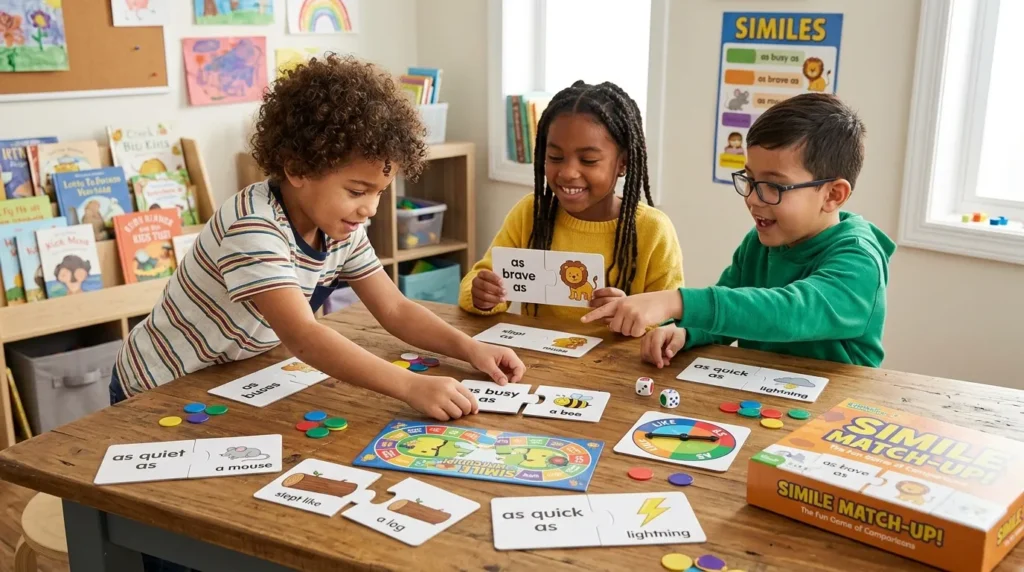
A simile is a figure of speech that compares two different things using the words like or as.
For example:
As busy as a bee: Someone who is very busy.
As light as a feather: Something that weighs very little.
Runs like the wind: Someone who runs very quickly.
As brave as a lion: Someone who shows great courage.
Similes help children describe people, animals, objects, and feelings in imaginative ways.
Best Similes Games for Kids
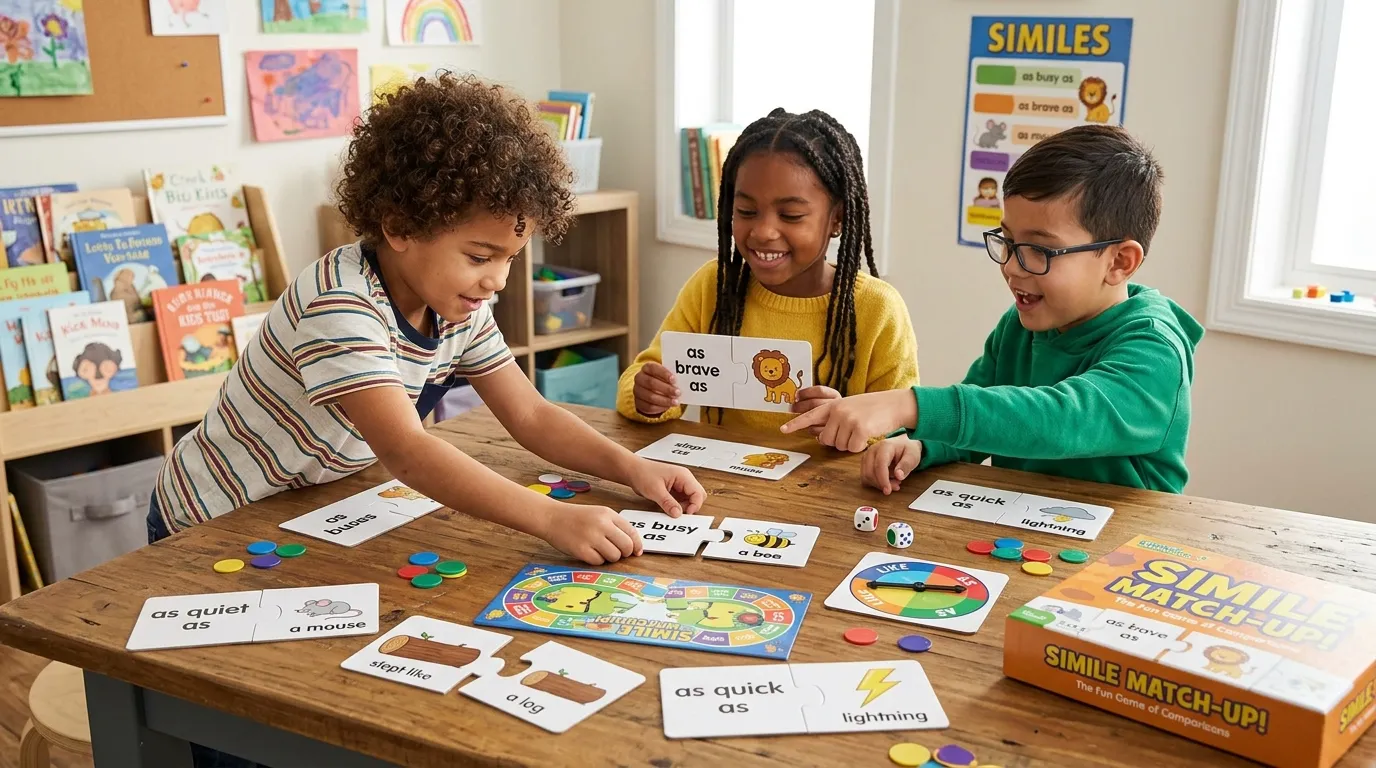
1. Simile Matching Game
How to play: Write the beginning of each simile on one set of cards and the ending on another. Mix the cards and ask children to match the correct pairs.
Match the following:
| Beginning | Ending |
|---|---|
| As busy as | a feather |
| As light as | a bee |
| As brave as | a lion |
| As cold as | ice |
| As quiet as | a mouse |
Learning goal: Children learn common similes and connect each comparison with its meaning.
2. Guess the Simile
How to play: Read a clue aloud and let children guess the missing word.
Try these questions:
As busy as a ______.
As brave as a ______.
As cold as ______.
As quiet as a ______.
As light as a ______.
As fast as a ______.
As strong as an ______.
As sweet as ______.
Answers: bee, lion, ice, mouse, feather, cheetah, ox, honey.
Learning goal: This game helps kids remember familiar similes while improving listening skills.
3. Finish the Simile
How to play: Give children an incomplete sentence and ask them to finish it with a creative comparison.
Examples:
The baby was as cute as ______.
The runner was as fast as ______.
My brother eats like ______.
The classroom was as noisy as ______.
Her smile shone like ______.
The snow was as white as ______.
Possible answers:
A kitten
The wind
A hungry bear
A busy marketplace
The sun
Cotton
Children can suggest their own answers as long as the comparison makes sense.
Learning goal: This activity develops imagination and sentence-building skills.
4. Simile Charades
<AsyncImage query=”children playing charades classroom acting out animals and emotions educational activity” aspectRatio=”16:9″ width=”100%” />
How to play: Write similes on small slips of paper. One child picks a slip and acts out the comparison without speaking. Other children guess the simile.
Ideas to act out:
As strong as an ox
As sleepy as a cat
As busy as a bee
As slow as a snail
As proud as a peacock
As sneaky as a fox
Example: A child pretends to move very slowly, and classmates guess “as slow as a snail.”
Learning goal: Children connect language with movement, expression, and meaning.
5. Draw the Simile
How to play: Ask children to draw a picture showing a simile. They can draw a literal or imaginative interpretation of the comparison.
Drawing ideas:
As tall as a giraffe
As bright as the sun
As quiet as a mouse
As happy as a lark
As slippery as an eel
As big as a house
Extra challenge: Ask each child to write a sentence beneath the picture.
Learning goal: This game helps visual learners understand figurative language and express ideas creatively.
6. Simile Bingo
How to play: Create bingo cards containing words such as bee, lion, feather, ice, mouse, and snail. Read the beginning of a simile, and children cover the matching word.
For example, say “As cold as…” and children cover ice.
Sample bingo clues:
As busy as a…
As brave as a…
As light as a…
As quiet as a…
As slow as a…
As slippery as an…
The first child to complete a row calls out “Bingo!”
Learning goal: Simile bingo strengthens listening, vocabulary recognition, and memory.
7. Create Your Own Simile
How to play: Challenge children to invent original similes about familiar things.
Give them these sentence starters:
My dog is as playful as ______.
The moon looks like ______.
My best friend is as kind as ______.
The wind sounds like ______.
The classroom is as busy as ______.
My favorite food tastes like ______.
Example answers:
My dog is as playful as a bouncing ball.
The moon looks like a silver coin.
My best friend is as kind as a warm hug.
The wind sounds like a whisper.
The classroom is as busy as a beehive.
Learning goal: Children practice creative thinking and learn to build original comparisons.
8. Simile Scavenger Hunt
How to play: Give children a list of things to find or describe around the classroom or home. They must create a simile for each item.
| Object | Example simile |
|---|---|
| A pillow | As soft as a cloud |
| A lamp | As bright as the sun |
| A clock | Ticks like a tiny drummer |
| A blanket | As warm as a hug |
| A toy car | Moves like a racing car |
Children can write their answers on a worksheet or share them aloud.
Learning goal: This activity helps children connect similes with everyday objects.
9. Simile Story Challenge
How to play: Ask children to write a short story using at least three similes. Give them a fun topic, such as a trip to the zoo, a magical forest, or a day at school.
Example story:
“Sam woke up as excited as a puppy. He ran to the zoo as fast as the wind. At the entrance, he saw a giraffe as tall as a tower and a monkey as playful as a clown. At the end of the day, he was as tired as a sleepy kitten.”
Learning goal: Children practice using similes naturally in sentences and stories.
10. Simile Quiz Game
How to play: Read each question and let children choose the correct answer. They can play individually, in pairs, or in teams.
Question 1: What does “as busy as a bee” mean?
A. Very lazy
B. Very busy
C. Very sleepy
Question 2: Which simile describes someone who is very brave?
A. As brave as a lion
B. As quiet as a mouse
C. As light as a feather
Question 3: Complete the simile: “As cold as…”
A. Honey
B. Ice
C. Sunshine
Question 4: Which simile describes something very light?
A. As heavy as a rock
B. As light as a feather
C. As slow as a snail
Question 5: What does “as slow as a snail” mean?
A. Moving very slowly
B. Moving very quickly
C. Making a loud noise
Answer key: 1-B, 2-A, 3-B, 4-B, 5-A.
Learning goal: This game checks children’s understanding of similes in a fun, low-pressure way.
Quick Simile Games for the Classroom
These short activities work well as warm-ups, lesson breaks, or end-of-class reviews.
Simile of the Day
Write one simile on the board each day. Ask students to explain its meaning and use it in a sentence.
Pass the Simile
Students sit in a circle. One student begins a simile, such as “As happy as…” The next student completes it. Continue around the circle with new comparisons.
True or False?
Read a statement and ask children whether it explains the simile correctly.
“As busy as a bee” means very busy. True
“As light as a feather” means very heavy. False
“As brave as a lion” means very courageous. True
“As slow as a snail” means very fast. False
Simile Sorting Game
Give children cards containing similes and ask them to sort them into categories such as animals, weather, feelings, size, and speed.
Benefits of Similes Games for Kids
Simile games can support language learning in several ways:
Build vocabulary: Children discover new words and expressions.
Encourage creativity: They invent imaginative comparisons and stories.
Improve comprehension: They learn that similes often have figurative rather than literal meanings.
Develop speaking skills: Games encourage children to explain their ideas and listen to classmates.
Make learning enjoyable: Interactive activities help make grammar lessons more engaging.
Tips for Teaching Similes Through Games
Start with familiar comparisons, such as “as busy as a bee.”
Explain the meaning before introducing more difficult examples.
Use pictures, gestures, and objects to help younger children understand.
Let children create their own similes instead of only memorizing common ones.
Encourage creative answers when the meaning is clear.
Adjust the activities to suit children’s ages and reading levels.