
What Is a Simile for a Volcano?
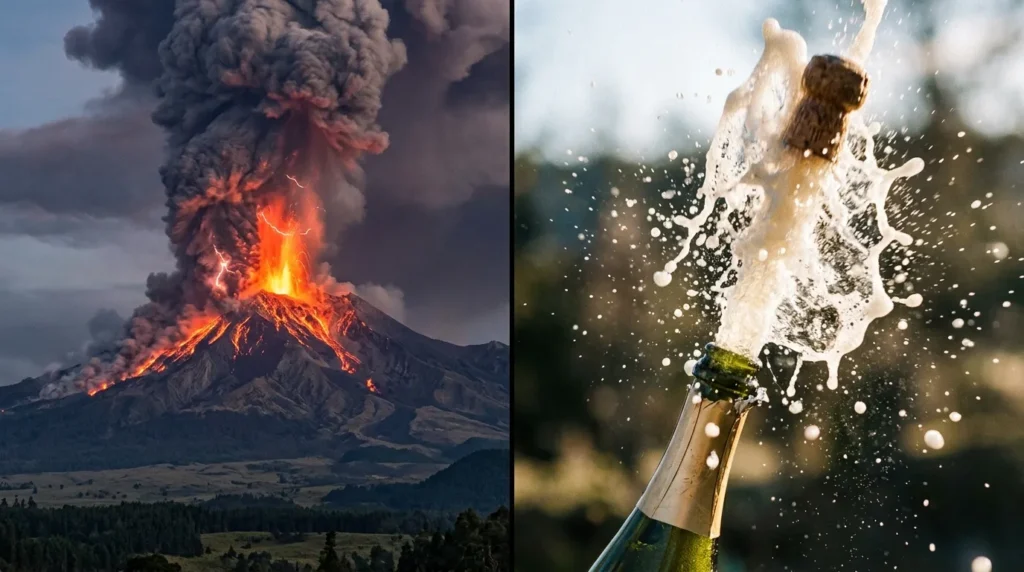
A simile is a figure of speech that compares two different things using words such as “like” or “as.” A volcano simile compares a volcano or one of its features with something familiar, helping readers picture its appearance, movement, sound, or power.
For example, “The volcano erupted like a giant firework” compares an eruption to a firework because both can release brilliant bursts of light and energy.
Writers can use volcano similes to describe:
Appearance: A volcano can look like a sleeping giant or a dark pyramid.
Heat: Flowing lava can glow like molten gold.
Movement: Lava can creep like a slow-moving river.
Sound: An eruption can roar like thunder.
Power: A volcano can explode like a bursting furnace.
The following examples offer different ways to describe volcanoes in creative and informative writing.
35 Similes for Volcanoes With Meanings and Examples
1. A Volcano Like a Sleeping Giant
Meaning: This simile describes a quiet volcano that appears peaceful but contains enormous hidden power.
Quote: “The sleeping giant rested beneath the clouds, hiding its fiery strength.”
Examples:
The volcano stood like a sleeping giant above the village.
Scientists watched the sleeping giant for signs of activity.
The mountain seemed peaceful, like a giant waiting to awaken.
2. Lava Like a River of Fire
Meaning: This comparison describes glowing lava flowing down a volcano’s slopes like a river made of flames.
Quote: “A river of fire wound its way through the dark volcanic landscape.”
Examples:
Lava flowed like a river of fire toward the valley.
The glowing stream looked like a fiery river in the darkness.
From a safe viewing point, we watched the river of fire move slowly downhill.
3. A Volcano Roaring Like Thunder
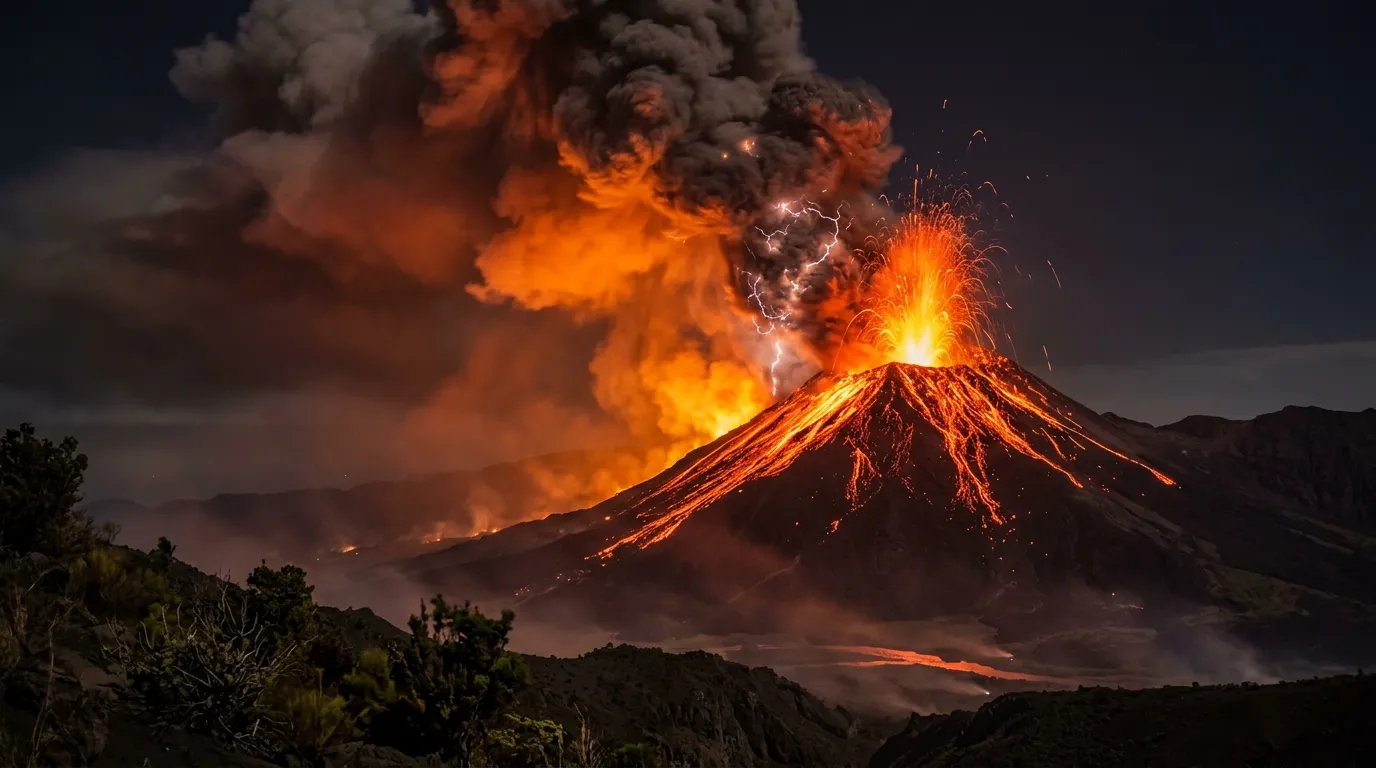
Meaning: This simile emphasizes the deep, powerful sound that can accompany volcanic activity.
Quote: “The volcano roared like thunder rolling across a stormy sky.”
Examples:
The eruption sounded like thunder echoing through the mountains.
A deep rumble rose from the crater like distant thunder.
The mountain roared like a storm breaking over the earth.
4. Lava Glowing Like Molten Gold
Meaning: This comparison highlights the bright golden-orange glow of hot lava.
Quote: “The molten lava shone like gold beneath the midnight sky.”
Examples:
The lava glimmered like molten gold against the black rock.
Orange streams glowed like liquid treasure on the mountainside.
At night, the crater shone like a bowl filled with golden fire.
5. A Volcano Exploding Like a Giant Firework
Meaning: This simile describes the sudden burst of glowing material and ash that can shoot into the sky during an eruption.
Quote: “The volcano burst into action like a giant firework illuminating the night.”
Examples:
The eruption lit up the sky like a giant firework.
Sparks and glowing fragments rose like fireworks above the crater.
The sudden flash looked like a firework exploding over the mountain.
6. Ash Falling Like Gray Snow
Meaning: This comparison describes volcanic ash drifting down and covering the ground with a fine gray layer.
Quote: “Gray ash fell like winter snow over the silent village.”
Examples:
Volcanic ash covered the rooftops like gray snow.
Fine particles drifted down like snowflakes on a cold morning.
The road disappeared beneath a blanket of ash like a field after snowfall.
7. Smoke Rising Like a Dark Tower
Meaning: This simile emphasizes the height and thickness of a volcanic plume.
Quote: “A dark tower of smoke rose from the crater and stretched toward the clouds.”
Examples:
Smoke climbed into the sky like a dark tower.
A towering plume rose like a black column above the mountain.
The thick smoke stood like a giant pillar against the blue sky.
8. A Volcano as Hot as a Furnace
Meaning: This comparison emphasizes the intense heat associated with lava and volcanic vents.
Quote: “The volcanic crater glowed as hot as a furnace burning through the night.”
Examples:
The glowing lava looked as hot as a furnace.
The volcanic vent radiated heat like an open industrial furnace.
The fiery opening appeared as hot as a blazing oven.
9. Lava Moving Like a Slow-Moving Snake
Meaning: This simile describes lava winding around obstacles as it travels downhill.
Quote: “The glowing lava twisted like a slow-moving snake across the rocky ground.”
Examples:
Lava curled around the rocks like a snake searching for a path.
The orange stream moved like a snake through the valley.
A narrow tongue of lava slithered like a serpent down the slope.
10. A Volcano Trembling Like a Drum
Meaning: This comparison describes vibrations or rumbling that can occur before or during an eruption.
Quote: “The mountain trembled like a drum struck by an unseen hand.”
Examples:
The ground shook like a drum beneath the restless volcano.
A deep vibration traveled through the mountain like a drumbeat.
The volcanic slopes trembled as if a giant drum were beating underground.
11. Lava Bright as a Burning Star
Meaning: This simile highlights the striking brightness of glowing lava, especially at night.
Quote: “The lava shone like a burning star against the darkness.”
Examples:
A bright patch of lava glowed like a star in the night.
The crater flickered like a fiery star on the horizon.
Glowing rock shone like a star trapped inside the mountain.
12. A Volcano Like a Giant Chimney
Meaning: This comparison focuses on a volcano releasing smoke, gases, and ash into the atmosphere.
Quote: “The volcano rose like a giant chimney sending dark smoke toward the clouds.”
Examples:
The crater released smoke like a giant chimney.
A column of ash rose like smoke from an enormous chimney.
The mountain looked like a chimney connected to the fiery world below.
13. An Eruption Like a Bomb Going Off
Meaning: This simile conveys the suddenness and force of an explosive eruption.
Quote: “The eruption burst into the sky like a bomb going off in the distance.”
Examples:
The sudden blast sounded like a bomb exploding.
The eruption sent ash upward like a powerful explosion.
The mountain released a tremendous burst like an enormous firecracker.
14. Lava Spreading Like Melted Butter
Meaning: This comparison describes lava spreading over a surface, although actual lava can vary greatly in thickness and speed.
Quote: “The glowing lava spread across the dark rock like melted butter over warm bread.”
Examples:
The hot lava covered the ground like melted butter.
A thin stream spread over the slope like butter softening on toast.
The orange flow widened across the rocky plain like a smooth layer of melted butter.
15. A Volcano Looming Like a Dark Fortress
Meaning: This simile presents a volcano as a massive, imposing structure that dominates the landscape.
Quote: “The volcano loomed like a dark fortress guarding the distant valley.”
Examples:
The mountain rose like a fortress above the surrounding hills.
Its steep, shadowy slopes looked like the walls of an ancient fortress.
The volcano stood like a stone castle against the horizon.
16. An Eruption Loud as a Cannon
Meaning: This comparison emphasizes the sharp, booming sound that may accompany an explosive eruption.
Quote: “The sudden blast rang out as loud as a cannon fired across the valley.”
Examples:
The eruption boomed like a cannon.
A powerful explosion echoed like cannon fire through the mountains.
The blast sounded as loud as a cannon during a battle.
17. Lava Flowing Like a Fiery Waterfall
Meaning: This simile describes lava cascading down a steep volcanic slope or cliff.
Quote: “Glowing lava poured down the rocky cliff like a fiery waterfall.”
Examples:
Lava descended the steep slope like a waterfall of fire.
Bright orange rock cascaded like a fiery waterfall.
From a distance, the glowing flow resembled a waterfall made of flames.
18. A Volcano Restless as a Caged Beast
Meaning: This comparison suggests that a volcano seems quiet on the surface while powerful forces remain active beneath it.
Quote: “The restless volcano seemed like a caged beast straining to break free.”
Examples:
The mountain appeared restless as a caged beast.
Rumbling beneath the crater made the volcano seem like a trapped animal.
The restless giant seemed ready to unleash its hidden strength.
19. Volcanic Ash Like a Dusty Curtain
Meaning: This simile describes ash spreading through the air and obscuring the landscape.
Quote: “A curtain of ash drifted across the sky, hiding the sun from view.”
Examples:
Ash spread over the valley like a dusty curtain.
The gray cloud hung like a curtain in front of the mountain.
A thick layer of airborne ash obscured the village like a curtain drawn across a window.
20. A Volcano Shaking Like a House in an Earthquake
Meaning: This comparison highlights strong ground movement associated with volcanic unrest.
Quote: “The ground shook like a house during an earthquake as the mountain rumbled.”
Examples:
The nearby ground trembled like a house during an earthquake.
The volcanic slopes shook as if a powerful quake had struck.
The tremors made the surroundings feel as unstable as a building during an earthquake.
21. Lava Like a Ribbon of Orange Light
Meaning: This simile describes a narrow, glowing lava stream winding across a dark landscape.
Quote: “A ribbon of orange light curled down the mountainside.”
Examples:
Lava traced the slope like a ribbon of orange light.
The glowing stream looked like a bright ribbon against the black rock.
From above, the lava resembled an orange ribbon winding through the valley.
22. A Volcano as Mysterious as a Hidden World
Meaning: This comparison emphasizes the unknown processes and concealed forces beneath a volcano’s surface.
Quote: “The volcano seemed as mysterious as a hidden world beneath the earth.”
Examples:
The dark crater appeared as mysterious as a secret underground kingdom.
Scientists explored the volcano with the curiosity of travelers discovering a hidden world.
The mountain’s concealed chambers seemed as mysterious as an unexplored land.
23. Smoke Twisting Like a Giant Dragon
Meaning: This simile gives a volcanic plume a dramatic shape, making it resemble a dragon curling through the sky.
Quote: “Smoke twisted above the crater like a giant dragon rising into the clouds.”
Examples:
The plume curled like a dragon’s tail.
Dark smoke rose like a dragon breathing into the sky.
The swirling cloud looked like a giant dragon stretching across the horizon.
24. A Volcano as Powerful as a Thousand Storms
Meaning: This comparison emphasizes the immense force and energy of an eruption.
Quote: “The volcano unleashed its fury like a thousand storms meeting in one place.”
Examples:
The eruption seemed as powerful as a thousand storms.
The booming mountain sounded like several storms crashing together.
Its fiery display appeared as forceful as a thousand raging tempests.
25. A Crater Like a Giant Open Mouth
Meaning: This simile compares a volcanic crater to an enormous mouth, creating a dramatic image of an opening in the earth.
Quote: “The crater gaped like a giant mouth in the heart of the mountain.”
Examples:
The wide crater looked like a giant open mouth.
Dark rock surrounded the opening like the edges of a huge mouth.
The mountain’s summit appeared to have a mouth wide enough to swallow the sky.
26. A Volcano Covered in Clouds Like a Mountain Wearing a Veil
Meaning: This comparison describes clouds or mist partially hiding a volcanic peak.
Quote: “Clouds wrapped around the summit like a silver veil.”
Examples:
The volcano wore clouds like a veil around its peak.
Mist covered the mountain like a thin curtain.
The summit disappeared behind clouds as if the volcano were wearing a mysterious veil.
27. Lava Bubbling Like a Pot of Boiling Soup
Meaning: This simile describes bubbling or churning molten material in a volcanic setting.
Quote: “The glowing surface bubbled like a pot of boiling soup.”
Examples:
The molten material bubbled like boiling soup.
The volcanic pool churned like a pot left too long on the stove.
Bubbles burst across the glowing surface like soup boiling in a giant pot.
28. A Volcano as Unpredictable as a Wild Horse
Meaning: This comparison highlights the difficulty of predicting exactly when or how volcanic activity may change.
Quote: “The volcano seemed as unpredictable as a wild horse running across open land.”
Examples:
The restless mountain appeared as unpredictable as a wild horse.
Its changing activity reminded the team of a wild horse that could suddenly bolt.
The volcano’s behavior seemed as difficult to anticipate as a horse running free.
29. An Eruption Like a Curtain of Fire
Meaning: This simile describes a dramatic display of glowing material or lava spreading across part of a volcano.
Quote: “A curtain of fire illuminated the mountain’s dark slopes.”
Examples:
The glowing eruption looked like a curtain of fire.
Bright lava streaks spread like a fiery curtain across the hillside.
The mountain shone behind a curtain of orange light.
30. A Volcano as Ancient as Time
Meaning: This comparison emphasizes a volcano’s immense age and its connection to Earth’s long geological history.
Quote: “The ancient volcano stood like a monument older than human memory.”
Examples:
The weathered volcano looked as ancient as time itself.
Its rocky slopes seemed to hold stories from the distant past.
The mountain appeared as old as the earliest chapters of Earth’s history.
31. Ash Clouds Dark as Midnight
Meaning: This simile emphasizes the darkness of a thick ash cloud that blocks sunlight.
Quote: “The ash cloud spread across the sky, dark as midnight.”
Examples:
The sky grew dark as midnight beneath the ash plume.
Thick volcanic clouds looked as dark as a moonless night.
The afternoon became as gloomy as midnight when ash covered the sun.
32. A Volcano Like a Giant Pressure Cooker
Meaning: This comparison helps explain how pressure can build within a volcanic system before some eruptions. It is a figurative comparison, not a complete scientific model.
Quote: “The mountain resembled a giant pressure cooker, with hidden forces building beneath its surface.”
Examples:
The volcano was compared to a giant pressure cooker beneath the earth.
Pressure building inside the volcanic system made the analogy seem fitting.
The restless mountain seemed like a pressure cooker waiting for its contents to escape.
33. Lava Cooling Like Black Glass
Meaning: This simile describes the smooth, dark, glassy appearance that some volcanic rock can develop as it cools.
Quote: “The cooled lava gleamed like black glass in the morning light.”
Examples:
The volcanic rock shone like black glass.
Dark lava cooled into a surface resembling polished glass.
The solidified flow looked like a sheet of black glass across the ground.
34. A Volcano Like a Beacon in the Night
Meaning: This comparison highlights the bright glow of an active crater or lava flow against a dark landscape.
Quote: “The glowing crater shone like a beacon in the night.”
Examples:
The volcano glowed like a beacon on the distant horizon.
Orange light rose from the crater like a signal in the darkness.
The bright lava made the mountain stand out like a beacon after sunset.
35. A Volcano as Fierce as a Raging Lion
Meaning: This simile presents an active volcano as powerful, intimidating, and full of energy.
Quote: “The erupting volcano seemed as fierce as a raging lion defending its territory.”
Examples:
The volcano roared as fiercely as a raging lion.
Its explosive bursts made the mountain seem like an angry lion.
The fiery peak appeared as fierce as a lion roaring across the wilderness.
How to Use Volcano Similes in Writing
Volcano similes can make descriptions more vivid, but the best comparison depends on what you want readers to imagine. Choose a simile that matches the scene rather than adding several comparisons to every sentence.
1. In Creative Writing
Use volcano similes to establish atmosphere, suspense, or excitement.
Example: “The sleeping giant towered over the village, its summit hidden beneath a veil of clouds.”
This sentence creates suspense by suggesting that the volcano is quiet but powerful.
2. In Poems
Choose comparisons that create strong images, sounds, or rhythms.
Example: “A river of fire crossed the night, while smoke rose like a dragon in flight.”
This combination gives the poem a vivid visual image and a sense of movement.
3. In School Assignments
Select straightforward similes that clearly explain a feature of the volcano.
Example: “Volcanic ash fell like gray snow and covered the surrounding ground.”
This example is easy to understand and illustrates how ash can spread across an area.
4. In Science Writing
Use figurative language to help explain a concept, but distinguish it from a literal scientific description.
Example: “A volcanic plume can rise like a towering column, carrying ash and gases into the atmosphere.”
The comparison helps readers picture the plume, while the sentence retains its scientific meaning.
Volcano Similes vs. Volcano Metaphors
Similes and metaphors both compare things, but they do so differently.
| Feature | Simile | Metaphor |
|---|---|---|
| How it works | Makes an explicit comparison | Describes one thing as another |
| Common wording | Uses “like” or “as” | Usually avoids “like” or “as” |
| Volcano example | The volcano roared like thunder. | The volcano was a thunderous beast. |
| Main effect | Makes a similarity clear | Creates a more direct image |
Both techniques can improve creative writing. Use a simile when you want to show a clear resemblance, or a metaphor when you want to create a more direct and dramatic impression.